
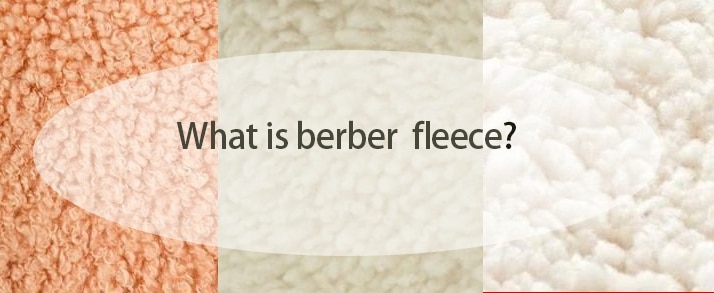
Before talking about what is Berber fleece, let’s first have a look at what is lamb wool.
Know about Lamb Wool
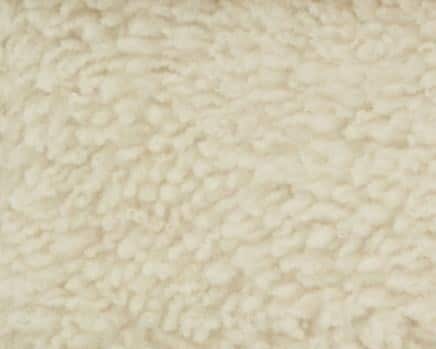
Lamb wool is taken from the sheep when it is first sheared (typically around 7 months of age). It is naturally soft, smooth, and elastic—significantly more refined than ordinary wool. Therefore, the yarn spun from this premium material offers superior hand-feel and higher thermal performance than standard wool, albeit at a higher price point.
Because the length and fineness of Lamb wool sit between traditional wool and cashmere, it functions as a “high-grade wool” material. Its market value reflects this positioning, offering natural insulation that is softer and warmer than bulk wool.
Technical Features:
- Source: 100% Natural animal fiber
- Attributes: High elasticity, superior breathability, biodegradable.
- Market Positioning: Premium tier, higher sourcing cost.

Then what is Berber Fleece?
Berber fleece is a high-performance synthetic fabric engineered to be extremely warm, soft, and lightweight. Characterized by a curly, slightly nubby texture and a subtly flecked appearance, it often features a plush sweater-knit backing. Comparable in softness and insulating properties to natural fur, it boasts a high warmth-to-weight ratio.
In the textile industry, it is often referred to as “faux lamb wool.”
It is a synthetic technical textile, usually constructed from a 70% polyester and 30% acrylic high-speed warp knitting process. This allows it to mimic the fluffy feel of lamb hair while offering superior durability and shape retention compared to natural protein fibers.
There is a distinct difference between lamb wool and Berber fleece. While Berber fleece is synthetic and does not hold the same luxury commodity value as cashmere, it serves as a powerful natural insulator in technical outerwear and activewear.
The Key Differences: Lamb Wool vs. Berber Fleece
To help B2B buyers make informed procurement decisions, we have summarized the technical differences below:
| Feature | Lamb Wool (Natural) | Berber Fleece (Synthetic) |
| Composition | 100% Natural Protein Fiber | 70% Polyester / 30% Acrylic |
| Weight (Typical) | Varies by weave | 280 – 450 GSM (Heavyweight warmth) |
| Durability | Delicate; requires specific care | High; resistant to deformation & shrinking |
| Sustainability | Biodegradable | Available in GRS Certified Recycled Poly |
| Applications | Luxury overcoats, premium knitwear | Technical fleece, hoodies, home textiles |
1. Different Components
- Lamb Wool: Harvested from the first cut of a young sheep; intermediate in fineness between wool and cashmere.
- Berber Fleece: A high-grade synthetic wool alternative; engineered for consistency and mass-production reliability.
2. Different Nature
- Lamb Wool: Natural, soft, and elastic with a fine suede texture.
- Berber Fleece: Imitation shearling; the chemical composition (70% Poly/30% Nitrile/Acrylic) provides high tensile strength and moth resistance.
3. Different Application
- Lamb Wool is a staple in high-end winter fashion, often used in leather jacket linings or luxury long coats.
- Berber Fleece is a cost-effective powerhouse. Its excellent thermal effect makes it ideal for home textiles, toys, and the inner lining of heavy-duty winter parkas.
How to Identify Lamb Wool vs. Berber Fleece
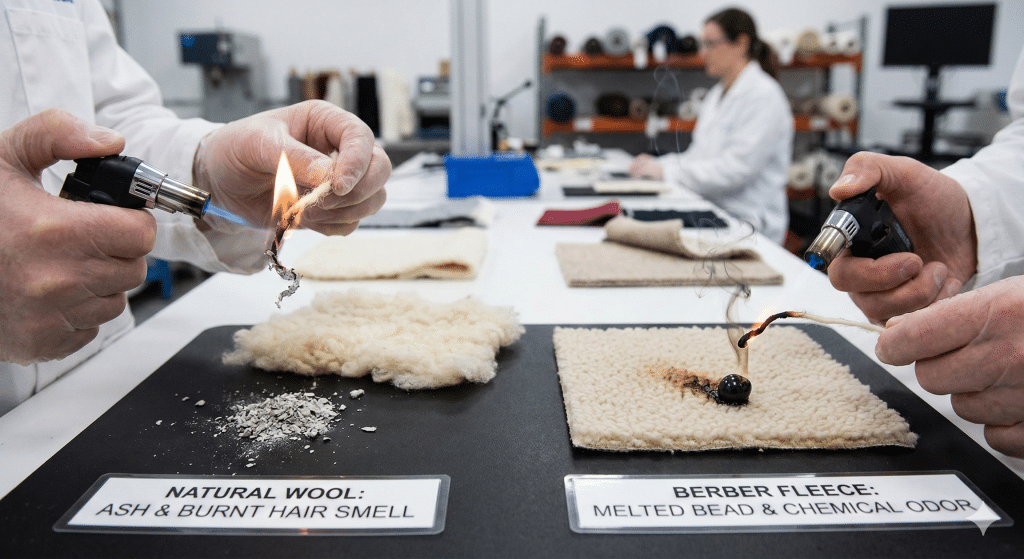
For quality control (QC) in the supply chain, you can perform a Burn Test on a hidden thread:
- True Wool: Becomes fragile ash when burned; smells like burnt hair (protein).
- Berber Fleece: Melts into a hard, scorched bead; emits a pungent plastic odor.
As a versatile fabric in global fashion (popularized by brands like UNIQLO), Berber fleece offers a much lower price point than lamb wool, making it the strategic choice for high-volume ROI.
Expert Specifications of High-Quality Berber Fleece:
- Breathability: Enhanced through warp-knit spacing.
- Texture: Soft, light, and elegant drape.
- Stability: Undergoes high-temperature shrinkage treatment to prevent pilling.
- Resistance: Excellent alkali, chemical, and mold resistance.
Know about Polar Fleece
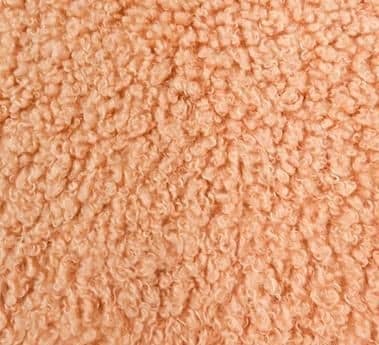
Another essential fabric in the activewear supply chain is Polar Fleece. Unlike the nubby pile of Berber, Polar fleece is made of polyester woven by a large circular machine and processed through dyeing, drawing, carding, shearing, and shaking.
According to the polyester specifications, it is categorized into:
- Staple Fiber Polar Fleece: Used primarily for cost-effective garments.
- Filament Polar Fleece: Higher durability, often used for household carpets and high-end activewear.
Polar fleece has a shorter history, pioneered by Polartec in 1981. You can Click here to know more about what is pollar fleece.

While the initial manufacturing process was complex and costly, industry leaders like Uniqlo have optimized the production technology. Today, it is an essential, affordable winter staple known for being lightweight and quick-drying.
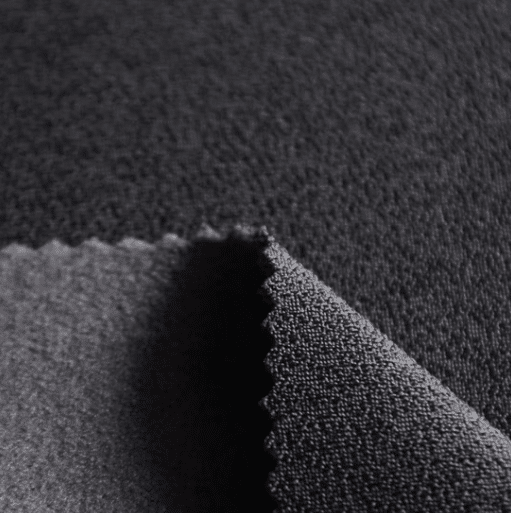
Polar fleece is highly versatile and can be bonded with denim or knitted fabrics to enhance windproofing and thermal defense.
- Final Summary: Artificial synthetic 100% polyester fiber; lightweight, cost-effective, and essential for modern layering systems.
What is the primary material used in Berber fleece?
Berber fleece is a technical synthetic textile, typically engineered from a blend of 70% polyester and 30% acrylic. High-end manufacturers often use GRS-certified recycled polyester to meet modern sustainability standards in the sportswear industry.
Is Berber fleece warmer than standard Polar fleece?
Yes. Due to its higher pile density and typical weight of 280-450 GSM, Berber fleece traps more air pockets, providing superior thermal insulation compared to the thinner, smooth surface of standard polar fleece.
Can Berber fleece be customized for high-performance activewear?
Absolutely. As an OEM/ODM specialist, we can bond Berber fleece with windproof membranes or knit outer layers (like denim or jersey) to create multi-functional outdoor apparel that combines aesthetic appeal with extreme weather protection.
How does Berber fleece perform in terms of durability compared to natural wool?
Berber fleece is significantly more durable for active use. It is resistant to shrinking, moth damage, and mechanical wear. Unlike natural lamb wool, it is machine washable and maintains its structural integrity after repeated high-intensity use.
Looking to develop a custom Berber fleece collection? As a leading manufacturer, we provide GRS-certified sustainable fabrics and full-service OEM/ODM solutions. Let’s discuss how our localized quality control (QC) can secure your next order.
