
Quick Overview: The Hybrid Activewear Market
A properly engineered sports bra for swimming closes the distance between hydrodynamic efficiency and high-impact structural support. For B2B sourcing managers and private label founders, partnering with a swim-specific manufacturer is a deliberate market positioning decision — one that determines your return rates, your brand equity, and your share of the fast-expanding triathlon and cross-training segments.
Why B2C Brands Fail: Swim-Specific Sports Bra vs. Regular Activewear
Standard yoga bras and the pool are fundamentally incompatible. Regular sports bras degrade under chemically treated water, and the structural consequences show up in your review feed before they show up in your quality control reports.
A high-quality sports bra for swimming is engineered around three non-negotiables: unrestricted movement, long lasting use, and zero chafe under sustained aquatic stress. Market failure analysis — drawn directly from verified 1-star reviews — consistently surfaces two manufacturing breakdowns that destroy brand trust:
- “Bleached out quickly with chlorine” — Consumers report visible fading after as few as two pool sessions. This is a failure to apply chlorine resistant treatment at the polymer level, not just the surface.
- “Band twists up in the wash” — Buyers report spending upwards of 30 minutes straightening twisted underbust bands. This structural failure is a direct consequence of factories skipping Tack Stitching to protect margins.

Expert Insight: Real hybrid performance is a molecular and structural engineered commitment — not a topical finish. Cotton must be eliminated from swim specs entirely. It absorbs water, increases weight under load, and sags when wet, compounding both performance and aesthetic failures simultaneously.
Chlorine Resistant Fabrics and Chemical Treatments
In a swimwear context, chlorine resistant means the polymer chains of the elastomer are architecturally capable of withstanding oxidation from hypochlorite — not just coated to delay it.

We deploy a dual-stage anti-chlorine auxiliary treatment: chemical protectants are introduced at the yarn manufacturing stage, and a secondary auxiliary is applied during the high-pressure dyeing process. This dual intervention guarantees Level 4+ colorfastness, ensuring your stock arrivals are commercially viable from day one and internationally compliant from the outset.
Fabric Comparison: PBT vs. Nylon Blends
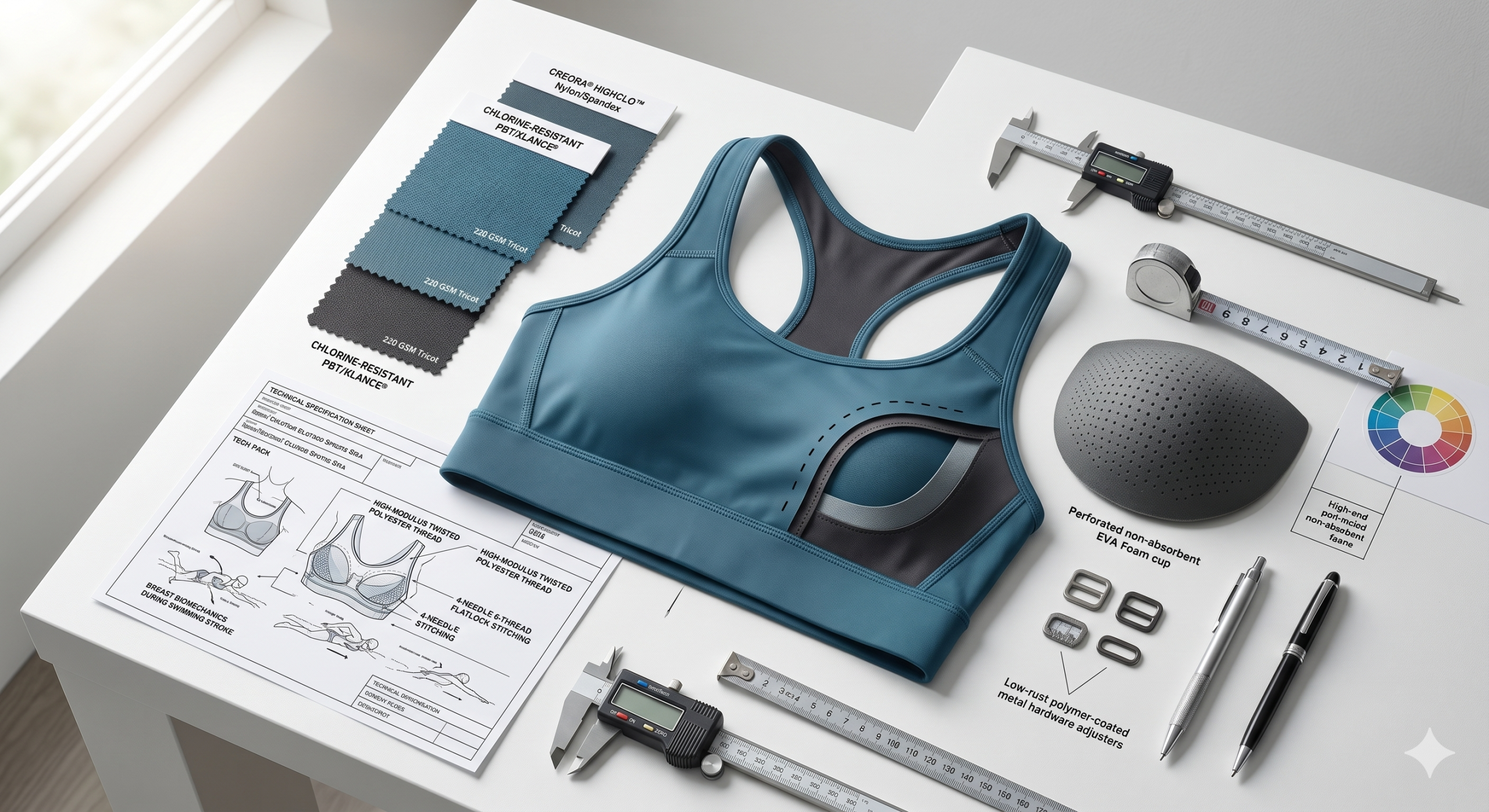
The base fabric is the single most consequential decision in swimwear engineering. We recommend a 220–250 GSM Tricot warp-knit structure as the structural baseline for all swim bra programs.
- Nylon/Spandex Blends with Creora® HighClo™: Deliver outstanding stretch and recovery across extended pool use. Creora® HighClo™ spandex was engineered specifically to prevent the rapid degradation that standard spandex experiences in chlorinated environments — brands sourcing generic elastane are buying a liability, not a fabric.
- Polyester PBT & XLANCE® Elastomer: Fabrics such as Nautilus (78% recycled polyester, 22% XLANCE® elastomer) consistently outperform standard elastane across every measurable swimwear metric. XLANCE® shows no tendency to shed microfibers, delivers exceptional UPF 50+ protection, and blocks over 98% of harmful UV rays. For brands building sustainable or performance-first positioning, this is the fabric architecture to specify.
Engineering Design Features That Improve Performance
Custom sports bras for swimming are designed around a brand’s proprietary logos, colorways, and structural blueprints. To ensure ultimate performance across all end-use conditions, your tech pack must address every one of the following engineering decisions:
- Straps & Mobility: Racerback and cross-back strap configurations deliver the full range of shoulder mobility that swim and cross-training demand. Strap width and height adjustments rely on low-rust Polymer-Coated Zinc Alloy hardware, which eliminates corrosion as a warranty and aesthetic concern.

- Closures & Fit: A secure, compressive fit prevents the bra from riding up during dynamic movement in water. We use 4-Needle 6-Thread Flatlock stitching or seamless construction to eliminate chafe at every contact point, maximizing absolute comfort.
- Padding Dynamics: Heavy padding saturates with water, increasing drag and weight and compromising the swimmer’s silhouette and performance. We engineer minimal, removable perforated EVA/PU foam cups that drain instantly, maintaining support without introducing hydrodynamic resistance.
Manufacturing Versatile Pieces: Styling And Cross-Training
Modern swim consumers do not compartmentalize their activewear. They want versatile pieces that move with them from the pool deck to the training floor without requiring a wardrobe change. When you write product descriptions for these programs, position them as cross-training essentials with a swim-first architecture.
A sleek black high-impact style pairs naturally with swim bottoms, boardshorts, or compression tights. Complete the look with layering guidance for post-swim wear — cover-ups, mesh tops, zip warmers — so buyers feel confident and stylish at every stage of their session, not just in the water.
Tech Pack Specifications: Fit, Sizing, And Cataloging
Measurement accuracy in swim bra programs requires discipline. Size for the bust using a tape measure held parallel to the ground at the fullest point. Find the natural crease at the waist for the underbust reference. Any deviation in these reference points compounds through grading and produces fit failures at scale.
For B2B brands managing significant inventories, catalog integrity is as operationally critical as garment construction. When you place wholesale items into your procurement cart, our team structures the data alongside the product:
- Data Integrity: We map every sku and barcode to its precise tech spec, eliminating discrepancies between physical goods and digital records.
- Digital Assets: We supply high-resolution jpg files with properly optimized alt text and title tags, formatted to import cleanly into your e-commerce environment.
- E-commerce Sync: Every attribute — including whether an item is taxable (true or false, never left as null) — is documented and structured so your team can find and configure all options without manual reconciliation. We provide a reliable way to import your full catalog directly into your CMS.
OEM Portfolio: Compare Models And Use Cases
We engineer multiple swim bra configurations across support levels, chlorine resistance technologies, and target use cases. The right model depends on your customer profile and the performance context you are designing for.
| Model / Pieces | Support Level | Chlorine Resistance Tech | Best Use Case |
| Racerback Swim Bra | High | Creora® HighClo™ Spandex | Lap swimming, Triathlons |
| Adjustable Strap Swim Bra | Medium | Dual-Stage Dyed Nylon Blend | Water aerobics, Surfing |
| Longline Swim Bra | Medium-High | PBT / XLANCE® Elastomer | Gym-to-pool transition |
End-User Care Guidelines for Long Lasting Use
Protecting your brand’s reputation post-purchase requires equipping your buyers with care protocols that actually work. A bad review rooted in improper care is still a bad review — and a false warranty claim is a margin and logistics problem you can prevent.
- Provide step-by-step rinsing instructions for immediate use after every pool session to clear chemical residue before it begins to work on the fabric.
- Recommend gentle washing with mild detergents, keeping the garment away from high-heat cycles.
- Advise air-drying flat, away from direct sunlight, to preserve elasticity and structural integrity across the garment’s full lifecycle.
Elastic Degradation: Damage Signs And Replacement Timing
Every swimwear garment has a finite lifecycle — the best ones simply make that lifecycle significantly longer. Train your customers to recognize legitimate wear indicators: fabric becoming sheer under tension, the underbust band bagging and losing its return force, or visible loss of compressive recovery in the cups or body panel. When these signs appear, the garment has reached end-of-life. Clear communication about replacement timing reduces negative reviews and sets accurate expectations from the point of purchase.
Sourcing Guide: What To Look For in a Manufacturer
When you shop for a manufacturing partner, generic capability claims are not a qualification. You need documented, engineered solutions with third-party verification.
- Prioritize manufacturers who provide chlorine resistance testing reports — not marketing language, but lab-certified data.
- Prioritize stretch recovery credentials; High-Modulus Twisted Polyester Thread is the stitching standard that ensures seams remain intact under repeated aquatic stress without thread-popping.
- Audit closure systems and verify that all hardware is certified corrosion-resistant before committing to a production run.
FAQs: Manufacturing & Material Sourcing
Are regular sports bras safe for pools?
No. Regular sports bras are not engineered for chemically treated water. Standard spandex breaks down under chlorine exposure, causing the garment to sag and lose compressive recovery. Cotton and heavy padding absorb water, increasing weight and defeating the structural purpose of the bra entirely. A sports bra for swimming requires swim-specific fabric architecture from the yarn stage forward.
How do you treat chlorine stains and odor?
Prevention is the correct engineering response — not remediation. Quick-drying synthetic fabrics combined with proper anti-chlorine auxiliary treatments at the manufacturing stage resist chemical absorption and the odor that follows. For end-users, a cold water rinse immediately after pool use is the single most effective habit for extending garment life and keeping chlorine stains from setting.
What certifications should sourcing managers require?
At minimum, require OEKO-TEX Standard 100 compliance documentation. For brands entering regulated markets or building ESG-forward positioning, verify that your manufacturer maintains audit-ready quality control systems, not just certification claims.
What is the minimum order quantity for a custom swim bra program?
MOQ varies by fabric selection, construction complexity, and colorway count. Contact our sourcing team directly for a program-specific breakdown — we work with brands across early-stage private label and established wholesale volume alike.
How long does sampling take before bulk production?
Standard sample development runs 15–25 business days depending on tech pack completeness. Brands that submit detailed, accurate tech packs from the outset move through sampling significantly faster. We recommend requesting a fabric swatch book before finalizing your spec so material decisions are locked before sampling begins.
Where To Buy Bulk: Sampling and Certification
Before committing to bulk production, sourcing managers must verify certifications and hold physical samples in hand. Maes Group guarantees OEKO-TEX Standard 100 compliance and maintains strict quality control across every production stage.
We invite premium brands to join our global network of successful private labels. For those needing immediate stock for testing or market entry, we also provide a premium range of Unbranded Gym Clothing available for fast delivery. We will help you find the right price point without sacrificing the technical quality your market demands. Our OEM/ODM process is designed to be genuinely supportive — from first design brief to final delivery, you have a dedicated team, not a ticket queue.
Ready to build your next high-performance swim collection?
Drop us an email today to request a fabric swatch book or start with a sample run.
