
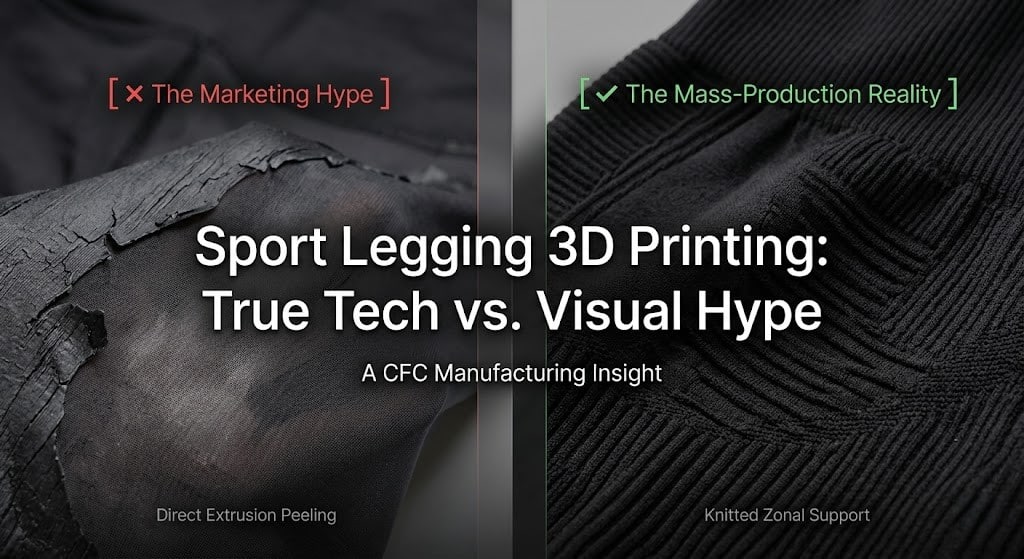
When sourcing high-performance apparel, sport legging 3d printing has emerged as a highly searched, yet fundamentally misunderstood technology in the modern activewear space. Brand founders and product developers frequently view this manufacturing method as the definitive, silver-bullet move to add futuristic aesthetics and high-tech credibility to their catalog. But when a product inevitably transitions from an idealized design concept to the harsh realities of mass manufacturing, textile engineering facts collide hard with marketing hype.
In our view, to add genuine, defensible commercial value to any product line, brands must intimately understand what sort of manufacturing actually works and scales on a global level. We have meticulously analyzed and stress-tested numerous prototypes across our advanced facilities. This detailed report cuts through the industry noise, exposes the structural and thermal failures of additive polymers on stretch garments, and presents the commercially scalable alternatives that successful brands add to their portfolios to achieve genuine structural support without compromising on performance.
Market And Use Cases
Before designing a tech-pack or committing to any specific product direction, mapping the exact use case is entirely non-negotiable. Muscle stabilization demands differ sharply by athletic discipline. For example, long-distance running requires linear impact absorption across the full stride cycle and high-level joint stabilization, whereas high-intensity yoga or Pilates demands ultimate, unrestricted flexibility in every direction. If you want to add meaningful performance features for dedicated athletes, you must start with that granular specificity.
Industry research and our proprietary factory data consistently reveal the exact same cognitive gap: buyers searching for high-tech manufacturing do not actually need true polymer additive manufacturing. To sort out the confusion cleanly and guide your sourcing strategy, we divide market intent into two distinct categories:
- Visual 3D: Brands seeking optical illusions—such as mecha-style armor silhouettes, anatomical shadow lines, or aggressive geometric prints—to add a vibrant color profile to a product. The ultimate goal here is pure visual perception and aesthetic differentiation, not physical structure or biomechanical support.
- Structural 3D: Brands desiring physical, tactile depth and targeted compression panels to add physical stabilization without relying on rigid plastics. These brands need a product that physically grips the muscle groups, enhancing blood flow and reducing oscillation during heavy movement.
Fit, Wearability, And Wear Trials: The “Cheap 2D” Disaster

When brands attempt to bypass engineering and add cheap 2D patterns to a product merely to fake 3D depth, the commercial outcome is a catastrophic failure. Through analyzing real end-user wear trials and authenticated Amazon customer reviews, we have identified the four most devastating complaints that destroy brand reputation and lead to massive return rates at scale:
1. Squat-Proof Failure (The “White-Out” Effect) Cheap suppliers often add low-GSM (Grams per Square Meter) white base fabrics to save money on the production line. When the material expands under heavy body load during a workout, the white substrate aggressively shows through, instantly erasing the printed design. Real buyers put it plainly:
- “The fabric is very thin and they are nowhere near squat proof… very sheer.”
- “Wear a long shirt and you’ll be fine… especially see-through if you squat.”
2. Unflattering Fit and Structural Collapse A flat print cannot add physical biomechanical stabilization. The moment a 3D-effect pattern meets real body contours in motion, the visual form collapses entirely. Compression zones flatten, and the silhouette distorts in the worst possible way:
- “These leggings squish my butt up into a weird kind of unpleasant mom jeans butt.”
3. Print Distortion & Synthetic Feel Low-resolution sublimation equipment reduces complex, precision designs to blurred, amateurish messes. Furthermore, when cheap synthetic materials are used to cut costs, they completely destroy the tactile feel of the garment. You simply cannot add a premium price tag to a product with poor color application and a rough texture:
- “The print is all faded out & not as sharp as the picture shows. It looks like an abstract… feels synthetic.”
- “The product ordered was different from what I received… pattern is different and less appealing.”
- “The fabric is not buttery soft. Instead a cheap polyester.”
4. Quality Control Nightmares When sourcing decisions are based entirely on a visual gimmick rather than manufacturing discipline, fundamental construction quality is quickly abandoned:
- “It bunches up unlike conventional leggings. No hem on one leg.”
Materials Evaluated: The Bottleneck
If cheap surface printing fails to deliver, the logical follow-up question is: why not add actual 3D printed polymers directly to the product? In our extensive laboratories, we evaluated both Thermoplastic Polyurethane (TPU) and liquid silicone as direct-extrusion materials across dozens of performance fabrics.
Our mass-production feasibility data highlights severe, unavoidable bottlenecks. Traditional activewear fibers carry a diameter of roughly 10 to 50 microns, creating an essential network of micro-pores for critical moisture management. In stark contrast, if you add a continuous 3D printed thermoplastic layer (usually measuring 0.5 to 2 millimeters thick), you physically and permanently block the fabric’s pores. This reduces breathability to absolute zero, causing severe overheating during any sustained aerobic activity.
Furthermore, bonding a rigid 3D structure onto a spandex-dominant fabric severely restricts multi-directional elasticity, resulting in what we call 4-Way stretch degradation. Leading sports brands only add this rigid technology to small-batch footwear prototypes or rigid protective gear, not mass-market soft apparel. Finally, there is a high delamination risk; after just a few standard industrial washing cycles, the rigid polymer coatings inevitably begin to peel and crack off from the base material.
Printing Methods Compared
To understand why true additive manufacturing hits a massive wall with soft goods, we must view the hardware side of the equation and evaluate the current technological landscape.
- FDM (Fused Deposition Modeling): FDM uses heated nozzles to melt and deposit polymers layer by layer. When you add extreme high heat directly to delicate spandex blends, you severely damage the textile fibers before the print even sets, rendering the garment useless.
- SLS (Selective Laser Sintering): While SLS delivers excellent results for rigid industrial prototypes, the powdered sintering materials lack the soft, skin-friendly flexibility required for next-to-skin activewear products.
- SLA (Stereolithography): SLA uses UV-cured liquid resins. The resulting structures are notoriously brittle. They easily fracture under the repetitive stretch and compression cycles of intense athletic movement.
Instead of fighting the physics of these machines, we highly recommend engineered hybrid approaches to add the desired high-tech aesthetic without compromising the physical integrity of the product.
Design And Patterning
Creating a functional, highly supportive 3D-effect product begins rigorously in the digital realm. We map out specific muscle groups—such as the glutes, quadriceps, and hamstrings—that benefit immensely from targeted stabilization. Modern factories utilize advanced parametric software so that as the product size grades from extra-small to extra-large, the 3D support structures and visual depth elements scale proportionally. This meticulous attention to detail ensures that the biomechanical alignment fits every individual properly, rather than just stretching out and distorting like cheap flat prints. It is absolutely essential to add these parametric controls to any high-end performance product.
Performance Metrics And Tests
Rigorous, standardized laboratory testing is not an optional value-add; it is mandatory. In our facilities, we calculate the exact modulus of elasticity across both the warp and weft of the textile. We strictly define recovery metrics to ensure the product instantly snaps back to its original shape under repeated, heavy mechanical load.
As realized earlier through our extensive laboratory evaluation, true 3D polymer printing consistently fails these crucial benchmarks. In contrast, we set strict abrasion resistance tests to ensure our scalable manufacturing alternatives maintain peak performance over years of use. Advanced seamless technology successfully adds targeted compression while keeping elasticity loss well under 5% after repeated use—a metric that separates premium activewear from fast fashion.
Manufacturing Workflow And Cost
Scaling successfully from a single prototype to global distribution requires a flawless, highly transparent supply chain. We map out production steps meticulously to estimate highly accurate per-unit costs for each product, ensuring brand founders understand their profit margins clearly.
Alternative 1: Advanced Sublimation (Visual 3D) For brands wanting to add the bold aesthetic of 3D without the heavy bulk of polymers, our high-definition digital sublimation lines offer a highly scalable, incredibly reliable workflow. The vibrant color inks bond directly with the material at a molecular level, completely eliminating the risk of delamination or peeling. We strictly utilize premium, high-GSM fabrics to add ultimate opacity, ensuring a 100% squat-proof product that never suffers from the dreaded “white-out” effect during heavy squats.
Alternative 2: Seamless Body-Mapping (Structural 3D) For brands that need authentic, tactile physical texture and functional compression zones, we abandon printing entirely and use state-of-the-art circular knitting machines. We directly weave Jacquard, ribbed, or honeycomb structures into the core of the product.

This advanced technique allows us to add thicker, highly supportive structures around the glutes and hips, while simultaneously we add light, highly breathable micro-mesh directly behind the knees. This sort of manufacturing provides superior, integrated compression areas without the need for rigid, uncomfortable surface overlays.

Testing Protocols And Standards
A premium product must always be backed by empirical, verifiable data. We strongly align our operations with recognized ISO textile standards. Our quality engineers set pass/fail criteria that are ruthlessly strict to protect your brand’s reputation.
For visual 3D sublimation lines, the color fastness must consistently reach an ISO rating of Grade 3.5 to Grade 4 or above. This strict requirement completely eradicates the “abstract faded” look that plagues low-tier competitors. To add further commercial value and trust, our materials fully support OEKO-TEX Standard 100 and Global Recycled Standard (GRS) certifications. We heavily advise brands to add these certifications to their portfolios to ensure chemical safety and demonstrate genuine environmental responsibility to their consumers.
Quality Assurance And Post-Processing
Maintaining absolute consistency across tens of thousands of production units requires militant, systematic oversight at every stage, not just random spot-checking. We clearly define QA checkpoints at every critical stage—from initial fabric cutting to final packaging. We thoroughly document post-processing steps, ensuring that materials are properly relaxed and heat-set so they do not shrink after the consumer’s first wash. We highly recommend utilizing advanced spectrophotometers to view and verify perfect color accuracy, ensuring every single product flawlessly matches the master digital design. Furthermore, we add automated optical inspection systems to detect even the slightest microscopic knitting flaw before the product is allowed to be packed and shipped.
Case Studies: Evaluated Prototypes
To properly illustrate the stark performance differences between these manufacturing approaches, we present three distinct prototype summaries. We view these breakdowns as essential learning tools for any B2B sourcing professional.
Prototype A: True TPU on Spandex
- Results: The product delivered an undeniable, futuristic visual impact right out of the box. However, athletes reported severe overheating within minutes because the TPU completely blocked all air circulation during running. Worse still, after just three industrial wash cycles, the plastic structures began to aggressively peel and flake off.
- Lessons Learned: You simply cannot add direct polymer extrusion to a mass-market activewear product due to inevitable thermal failure and rapid delamination.
Prototype B: Cheap 2D Sublimation on Low-GSM Polyester
- Results: The unit cost was highly favorable, but the garment catastrophically failed the basic squat test. The material turned completely white under tension, and the carefully designed optical illusion distorted heavily around the hips and thighs.
- Lessons Learned: Never compromise on base fabric weight just to save a few cents. You must add a minimum of 280-320 GSM fabric to maintain total opacity and protect your brand’s integrity.
Prototype C: CFC’s Seamless Body-Mapping Integration

- Results: By programming ribbed compression zones directly into the knit architecture, the product provided excellent, highly comfortable physical stabilization. It retained 100% of its critical moisture-wicking capabilities and exhibited an elasticity loss of less than 5% after rigorous mechanical testing.

- Lessons Learned: Integrating functional structure via the yarn itself is the ultimate, most reliable way to add scalable, high-performance 3D texture to a product line.
The Mass-Production Reality:
3D Activewear Comparison Matrix See exactly why successful brands abandon rigid polymers and cheap prints for engineered textile solutions.
| Performance Metric | True TPU 3D Print (Competitor) | Cheap 2D Sublimation (Competitor) | CFC Seamless & Advanced Sublimation (The Solution) |
| Breathability | ❌ Zero. Polymer layers seal fabric micro-pores, causing severe overheating during workouts. | ❌ Poor. Low-grade synthetic polyester traps body heat and sweat. | ✅ Maximum. Dynamic micro-mesh knitting and advanced moisture-wicking yarns. |
| Squat-Proof (Opacity) | ⚠️ Inconsistent. Rigid overlays restrict natural stretch, pulling the base fabric out of shape. | ❌ Fail. Low-GSM base fabric turns sheer and white under stretch (The “White-Out” effect). | ✅ 100% Guaranteed. Premium 280-320 GSM fabrics maintain total visual opacity under heavy load. |
| Delamination Risk | ❌ Extremely High. Rigid plastic structures peel and crack after standard industrial washing. | ⚠️ Fading Risk. Doesn’t peel, but low-res ink severely fades and blurs after stretching. | ✅ Zero Risk. 3D structures are knitted directly into the yarn; ink is molecularly bonded. |
| B2B Verdict | 🚫 Unscalable Gimmick. Fails athlete wear tests. High warranty claims. | 🚫 Brand-Damaging. High consumer return rates. Ruins brand equity. | 🏆 Commercially Scalable. Premium performance, durable, and built for global retail. |
Launch Plan And Retailing
Bringing these advanced, highly engineered products to the competitive market requires a thoughtful retail strategy. We strongly recommend pricing tiers that position Seamless Body-Mapped leggings as premium, high-performance gear aimed at serious athletes, while Advanced Sublimation leggings can perfectly capture the fashion-forward, athleisure market. We help dedicated brands add comprehensive go-to-market timeline strategies, ensuring that mass production aligns perfectly with critical seasonal retail drops. Finally, we suggest targeting retail channels that cater to educated consumers who view high-tech, genuinely squat-proof activewear as a worthwhile, long-term investment.
Sustainability And Recycling
As the global apparel industry rapidly evolves, so must its commitment to environmental responsibility. We rigorously evaluate total material recyclability from the very beginning of the supply chain. Our seamless knitting technology inherently reduces industrial waste since it builds the product directly from yarn, vastly minimizing fabric cut-offs compared to traditional methods. By intentionally incorporating recycled nylon and certified eco-friendly dyes, you can seamlessly add powerful ESG (Environmental, Social, and Governance) credentials to your next product line. We have fully realized that modern consumers demand genuine sustainability, not just empty marketing promises.
Content And Visuals To Include
For brand marketers, effectively translating technical manufacturing excellence into consumer-facing appeal is absolutely vital for conversions. We highly recommend that you commission professional process photography to allow your customers to view the precision and scale of the modern machinery utilized in creating their garments. Create engaging, exploded 3D renders of the product to visually highlight the targeted compression areas and breathable zones. Lastly, prepare highly detailed comparison charts to add clear, undeniable evidence of superior breathability and stretch recovery compared to traditional, low-quality gimmicks flooding the current market.
Appendix: Resources To Cite
Total transparency builds long-lasting consumer trust. When building your e-commerce product pages, we heavily encourage you to add official material datasheets outlining the exact GSM and fiber blend of the garment. Furthermore, proudly add testing standards references directly to your site so your highly educated customers can easily view that your bold claims of Grade 4 color fastness and total squat-proof opacity are backed by rigorous, verifiable ISO laboratory testing.
Stop Risking Your Brand Equity on Flawed Manufacturing
Transition from unscalable 3D printing gimmicks to commercially viable, highly engineered activewear. Whether your product requires Structural Seamless Body-Mapping or High-Definition Visual Sublimation, CFC delivers 100% squat-proof, zero-delamination results at global retail scale.
🔒 All designs and technical specifications are protected by our strict NDA policy. Our textile engineering team will review your requirements and respond within 24 hours.
FAQ: Frequently Asked Questions on 3D Printed Sportswear
Why do users want to add 3D printed leggings to their workout gear?
Users want to understand the benefits and features of 3D printed leggings for workouts and activities. They deliver superior muscle support, targeted compression, and dynamic breathability during high-intensity training—features that traditional products often lack.
How does the manufacturing process work?
Explores the technology and methods involved in bespoke manufacturing for sports apparel: Direct printing on fabric is the most common technique, where a 3D printer applies flexible materials directly onto a textile base. Designers use 3D printers to deposit materials, like TPU, directly onto traditional base fabrics.
Does this sort of manufacturing help reduce waste?
Yes. Because 3D printing is an additive process, it uses only the material needed for the design, significantly reducing fabric cut-off waste. As an additive process, it reduces material waste compared to subtractive manufacturing techniques, potentially saving up to 90% of natural resources.
Can you add customized sizing for my exact body shape?
Absolutely. 3D printing allows manufacturers to create garments tailored to an individual’s exact body measurements using 3D body scans. Athletes can undergo a full-body scan, and the digital data is used to print a product that fits their exact height, limb circumference, and muscle shape.
How do 3D structures improve athletic form?
Users might be interested in how 3D printed leggings can enhance posture and movement efficiency during exercise. It can create complex lattice or mesh structures that are difficult to replicate. The structured 3D printing pattern enhances performance by reducing muscle fatigue and improving circulation, especially during running. Dynamic compression applies graduated pressure to reduce muscle oscillation during movement. Clients reported a 30% improvement in form during exercises like deadlifts, and 22% more consistent hip alignment.
Are these high-tech products suitable for light and heavy environments?
Users may seek information on the versatility of 3D printed leggings for different activities and environments. They offer durability, UV resistance, and weather adaptability. The material includes light UV-protective fibers (UPF 50+) and a water-repellent finish, making them suitable for indoor HIIT, outdoor trail running, yoga, cycling, hiking, and casual outings.
What is the future of smart activewear?
The future lies in biomechanics. 3D printing allows the integration of sensors for biometric tracking directly onto the product. Conductive fibers can be printed into the material to track biometric data, such as heart rate or muscle activity, during a workout.
Still have questions about implementing Structural 3D for your brand?
