

Logo placement on leggings is constrained by the garment’s construction method (Cut & Sew vs. Seamless knitting), the stretch behavior of the fabric zone selected, and the decoration technique’s compatibility with that zone’s tension and curvature. Activewear brands frequently request logo printing on the waistband to maximize brand visibility. However, technical evaluations show this high-stretch area carries the highest risk of print fatigue, cracking, and peeling.
What is the standard or common logo placement on leggings?
The standard logo placement on leggings avoids high-stretch zones and focuses on low-curvature areas such as the upper left thigh, the back of the calf, or the outer ankle hem. Placing logos in these structurally stable zones minimizes the shear stress between the elastic fabric base and the non-elastic printing materials.
For custom apparel produced in our own factory, we evaluate optimal print areas based on AQL 2.5 inspection standards and recommend the following locations for maximum visual impact and durability:
- Upper Left Thigh: Offers a flat, low-tension surface ideal for heat transfer or screen printing.
- Back of the Calf: Highly visible during motion, maintaining proportional shape without stretching the design elements.
- Left Chest or Upper Back: For matching sports bras or tops, providing a professional look with minimalistic subtle branding.
Why placing logos on the waistband leads to cracking
Printing logos on the ribbed waistband fails because conventional non-elastic decoration materials cannot match the dynamic stretch rate of the waist zone, which commonly reaches 30%–50% during wear. Any rigid or high-build decoration applied here will inevitably fail under repeated flex and friction.
From a material mechanics perspective, attaching a rigid layer (like heat transfer vinyl) to a high-stretch base creates concentrated shear stress under cyclic loading. When the leggings are worn and stretched, the fabric expands, but the logo layer cannot. This physical conflict results in cracking. Furthermore, the waistband area endures the highest continuous friction and pressure against the body, accelerating the degradation of surface-attached prints.
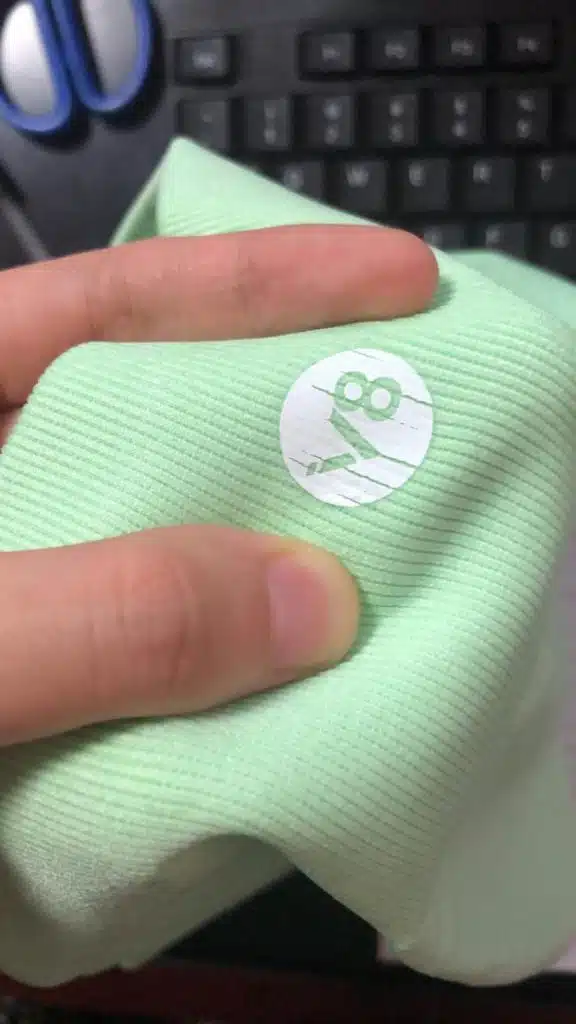
As demonstrated in the V8 client case above (image_4e9aa2.jpg), applying a heat transfer logo to a ribbed seamless waistband resulted in severe cracking along the rib lines. To resolve this durability issue, we relocated this client’s logo to the upper left thigh, successfully eliminating the cracking problem while maintaining a clean, fashion-forward streetwear aesthetic.
How do garment construction and fabric affect logo placement?
The manufacturing process—specifically Cut & Sew versus Seamless knitting—dictates the surface physical environment for logo application. Seamless knitted leggings are manufactured directly from yarn into garment tubes using specialized circular knitting machines. This process creates integral structural variations across the garment.
For example, using our Italian Santoni SM8-TOP2V and TOP2 FAST equipment, a standard 13-inch cylinder utilizes 1,152 needles (based on the 28 Gauge standard). The transition from the main leg body to a ribbed waistband involves complex stitch variations (such as tuck stitches and drop stitches). This significantly alters the fabric’s elastic modulus and surface texture, making external printing methods highly unstable.
Conversely, Cut & Sew leggings utilize specialized seaming, such as the 4-needle 6-thread flatlock or the 3-needle 5-thread coverstitch. These physical seams limit the available continuous print area. Additionally, the internal elastic bands required in Cut & Sew waistbands create an uneven surface, preventing the uniform pressure necessary for durable heat transfer application.
How do Lululemon, NVGTN, and AUROLA place logos on the waistband?
Brands like NVGTN and AUROLA do not rely on surface printing for their seamless leggings; instead, their logos are directly knitted into the fabric structure during production using jacquard technology. While some Cut & Sew brands like Lululemon utilize specialized reflective films on non-ribbed, smoother fabric zones, true seamless ribbed waistbands require a structural solution.
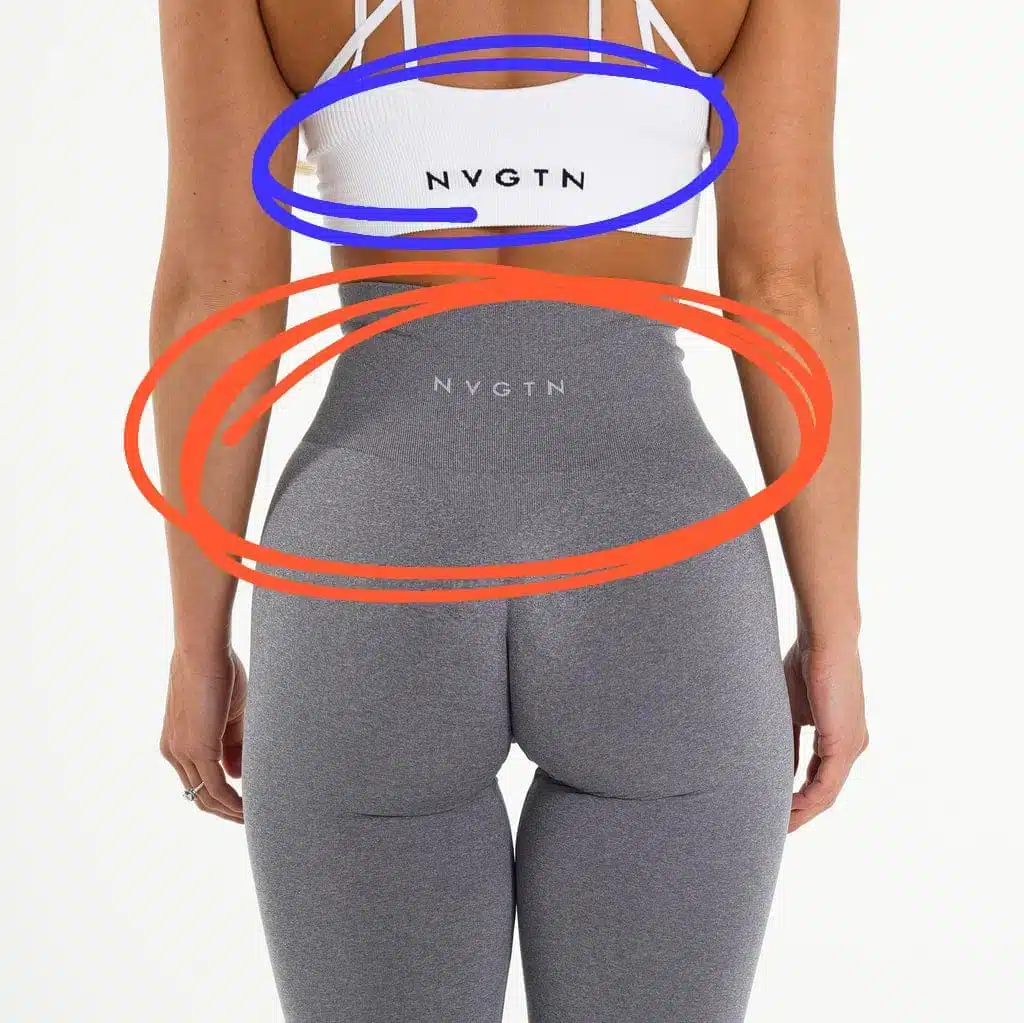
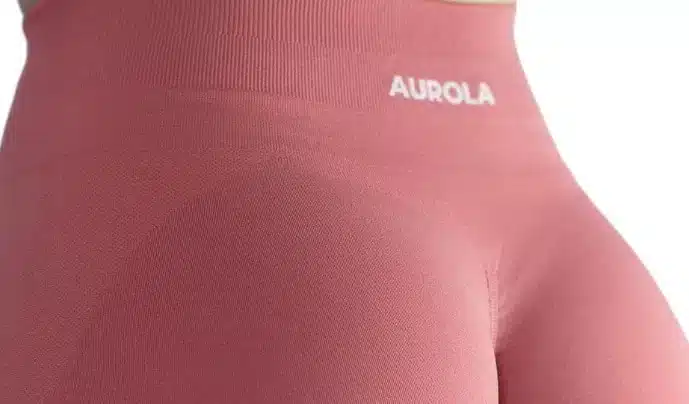
As shown in image_4e9abe.jpg (NVGTN) and image_4e9ac2.png (AUROLA), the wording is integrated directly into the garment. By programming the 28-gauge Santoni machines, the brand logo is created using contrasting yarns simultaneously with the ribbed structure. Because the logo is made of the same stretchy yarn (such as a high-percentage Spandex and Nylon/Polyester blend) as the rest of the waistband, it stretches 100% synchronously with the fabric, completely eliminating the risk of cracking.
Logo printing methods on stretch fabrics: Technical comparison
Different decoration techniques yield varying durability results on activewear. Below is a technical breakdown of application compatibility for high-stretch sportswear.
| Decoration Technique | Suitability for Ribbed Waistband | Recommended Placement | Technical Limitations |
|---|---|---|---|
| Seamless Jacquard Knitting | Excellent | Waistband, upper back, calf | Requires MOQ of 450-500 units/style. Cannot achieve intricate multi-color gradients. |
| Heat Transfer (Silicone/Vinyl) | Poor | Left thigh, back collar, hem | Prone to fatigue failure on areas exceeding 20% stretch. Requires flat, non-ribbed surfaces. |
| Screen Printing | Poor | Calf, center chest | Ink layer breaks apart over high-curvature or heavily ribbed textures. |
| Embroidery | Not Recommended | Left chest logo on tops, hoodies | Introduces rigid tension into stretch fabrics (e.g., up to 280 GSM GOTS organic cotton blends), puckering the garment. |
Next steps for technical validation
Determining the perfect logo placement requires matching your design elements to the specific fabric’s physical properties. Before finalizing your custom apparel tech pack, it is critical to evaluate the stretch modulus of your selected material against the elasticity limit of your intended printing method.
For custom production, we offer a rapid prototyping cycle of 8-15 days. We recommend submitting your logo vector files and placement guide to our engineering team to conduct physical stretch and wash durability tests prior to bulk manufacturing.
