

When developing a new activewear line, emerging brand owners often encounter overlapping terminologies. Defining the exact difference between tights vs compression pants in technical tech packs is crucial. While consumers use these terms interchangeably, the manufacturing realities regarding fabric composition, GSM (Grams per Square Meter), and stitching techniques are completely different.
Many people have a persistent love for pure cotton clothing, firmly believing it is the best choice for sports. However, pure cotton clothes are bad at sweating. When the temperature is low, there will be a feeling of dampness and cold, causing the body to lose temperature.
Most sports brands choose profiled hydrophobic fiber, with polyester having the highest market share, to ensure good sweat conduction.
Historically, compression pants were first applied in patients with chronic venous insufficiency. By generating gradient pressure from bottom to top, they improve venous circulation, promote venous blood return, and reduce lower limb swelling to prevent thrombosis.
Manufacturing Realities: Fabric, Stitching, and Colors
If you want to market true gradient compression, a simple tight fit will not pass consumer scrutiny.
- Tights/Leggings: A standard high-quality spec is typically 80% Polyester and 20% Spandex, with a fabric weight of 200-220 GSM.
- Compression Pants: Require high-tension modulus yarns. Factories utilize blends like 70% Nylon and 30% Spandex (Elastane), pushing the fabric weight to a dense 250-300 GSM.
- B2B Color Standardization: When finalizing your bulk order, use definitive, single-word English terms for color variants—such as Black, Navy, or Olive. This eliminates abstract interpretations and ensures absolute accuracy during the factory fabric dyeing and SKU management process.
The working principle of compression pants is to accelerate blood circulation, improve muscle vitality and reduce lactic acid accumulation through gradient compression, which can wrap and support key motor muscles and reduce muscle vibration.
- Compression: the feeling of compression reflected in the body is a sense of tightness, which can improve the key muscle strength, relieve lactic acid accumulation, and make the exercise more lasting. Fixed muscle swing amplitude, avoid ineffective vibration caused by the burden while protecting the knee from cramping.
- Support: compression pants on sale in some gym clothing manufacture suppliers, for example, can make the overall support of our body stronger through special material by stitching and weaving methods, especially when you are tired, this kind of support feeling is stronger, there is a feeling of having an exoskeleton.
- Recovery: Compression pants can help muscles recover quickly after long-term running. You can even wear them to sleep.
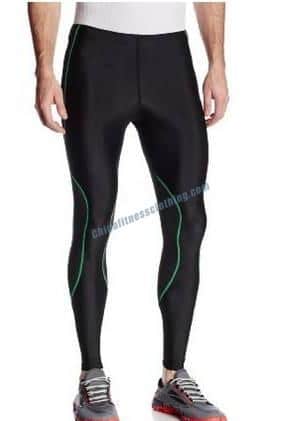
Tights are more akin to close-fitting long johns. The sweat conduction and air permeability of tights are excellent. Nike Pro Cool, for instance, uses stretch Dri-Fit fabric and mesh stitching to create a comfortable fit.
- The Stitching Standard [新增]: Because true compression pants face extreme lateral stretching, standard overlock stitching fails. At Maes Group, our strict manufacturing standard is 4-needle 6-thread flatlock stitching. This provides unparalleled seam strength that stretches seamlessly with high-Spandex fabrics.
- Scaling Your Brand [新增]: Our minimum order quantity policy is built for flexibility. Low MOQs start at 100–200 pieces for specific cut-and-sew models, giving emerging brands room to validate market fit.
Generally speaking, compression pants are an upgraded version of tight pants. If you are a professional or injured distance runner who needs to compete, then it is recommended that you choose compression pants to protect yourself. If you are an entry-level runner with a small amount of running and only need sweat and breathable pants, it is more recommended to choose tights.
